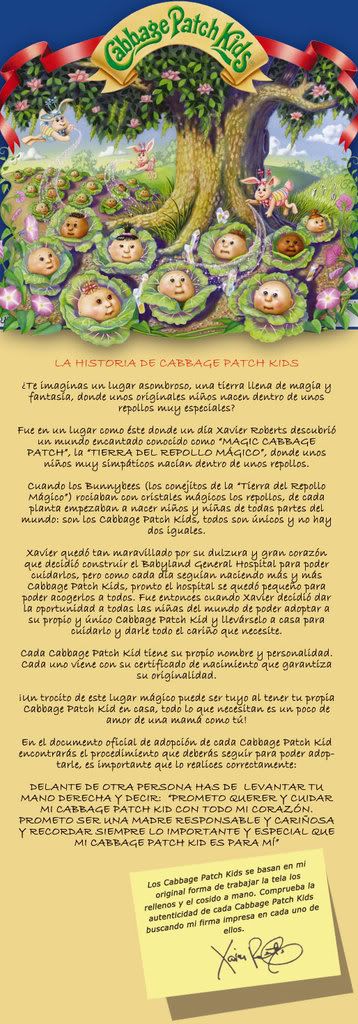
Chronological History: In 1976, a young 21-year Xavier Roberts created his first soft-sculptures and the next year given name,
calling them "little people" and incorporating their own birth certificate.
These dolls were and still are made entirely of cloth, the whole body and head are soft.
currently only be purchased in the Babyland General Hospital.
In 1978, Xavier with five of his school friends created the brand
Original Appalachian Artwork, Inc. and decide to restore a former medical center in Cleveland to transform
"Babyland General Hospital" and open to the public.
In 1981, the "little people" by Xavier appear in several major U.S. daily newspapers
In 1982, Original Appalachian Artwork, Inc. signed his first contract with a major manufacturer of toys, the company Coleco
and the little people
renamed "Cabbage Patch Kids" which is something as & amp; iacute; as Cabbage Half
Children.
In 1983, the Cabbage Patch Kids dolls become more successful in the history of toys.
In 1985, Cabbage Patch Kids join the youth program NASA's space
and travels the first doll
CPK space.
From 1985 to 1988
, develop new models of Cabbage Patch Kids (premature babies, baseball stars, clowns, children with grasping hands, toddlers and nursery children a) and introduces several molds of the head.
In C1989 HTMLXC
, goes bankrupt Coleco and Hasbro company takes over the wrists. In
1990, Hasbro launches its first edition, the llamdo "First Edition 1990"
and not only sold in the U.S. but is disclosed in various countries around the world between including Spain. so far taken 65 million Cabbage Patch Kids and are among the 10 best-selling brands of the year.
models are developed for children's birthday and children poses.
In 1991
is introducen peescolares children. In 1992
are honored to be chosen the official mascot of the U.S. Olympic team models are introduced Ruff N Tuff Boys, small Lullabies and my first Cabbage Patch Kids.
In 1993
appear babies who cry like a real one. Between 1994 and
1995, re-elected as official mascot of the U.S. Olympic team Hasbro stops making the Mattel CPK and is a new company that develops. children are introduced to eat and making happy sounds.
In
1996, are recalled children eat, because of legal problems (number of accidents among children who have these dolls because they bring accessories) In
1997, appear baby models and baby bubble bath fun divertido.También babies on vacation. To celebrate the 15 anniversary of the CPK
(since 1983) creates an empty girls' 16-inch size as the original CPK, and exclusive clothing collection box. In 1999
, CPK is voted to be the image of a stamp commemorating fifteenative of the 80's, the postal program to celebrate the 20 th century to celebrate the U.S. Postal Service models are introduced Millennium Celebration, infants and children surprise E-Doption.
In 2000
, go on sale CPK seals. In 2001
, Cabbage Patch Kids come stomping on the World Wide Web. In 2003 Mattel
stops making the CPK and Toys "R" Us get a special license to manufacture and market the dolls, introducing TRU Kids in New York, 20 inches in size and co nmemoración the 20 th anniversary
of these dolls (counting from 1983). These dolls are only available in the Babyland General Hospital
and Toys "R" Us. In
2004, the company Play Along became the latest toy to this day, to manufacture the CPK. distributes to different countries, under the name of national toy companies as is the case of IMC
in Spain. In 2006
, low silica IMCnce of Play Along
, marketed in Spain, Cabbage Patch Kids Fashion. In
2008 to commemorate the 25 anniversary of Play Along CPK sells a collection of baby sucking sweets (stained face) and another collection of dolls retro fashion wearing the 80. IMC
another model sold in Spain, the neonates. While companies
Coleco and Mattel only the CPK marketed in the U.S., in turn Xavier Roberts gave licenses to other comforeign toy panies to manufacture and market the dolls: *
Tri-Ang Pedigree
in South Africa. * Tsukuda in Japan. * Lily Ledi
in Mexico. * Jesman
for Coleco in Spain, Germany and Italy. Acronyms Different depending on the country where manufactured:
* IC
in Taiwan. * UT
in Taiwan. & amp; nbsp; * P
in Hong Kong. * PMI in China. * OK in China and Hong Kong. * KT in .......... *
WS / SS
on ......... head molds there are many, are represented by the initials of the company that makes and with a number that is in the bottom of the head from behind (in the neck) .
There are some dolls that have a kind of dimples on the face or do not have them but over time they appear, about
called "smallpox lI Cabbage and is an allergic reaction with some CPK. At the time of making the heads of vinyl plastic or rubber using a specific and mixed with a powder charge to give that peculiar sweet smell of these dolls. In some cases, depending on weather conditions and temperature changes that are exposed to the CPK, powders mixed with vinyl break down and give rise to these spots, but it is not ugly but are very funny dolls with those dimples in his cheeks.